
Flat roof covering
At the beginning of every design, you determine the performance and lifespan of the roof. The choice of the right roofing material for a flat roof has a direct impact on watertightness, thermal performance, maintenance, and compatibility with other roof layers. Deschacht Engineering supports you in selecting systems that comply with current standards and future sustainability requirements.
You take into account factors such as insulation value, retention, load-bearing capacity, and material compatibility. The right choice varies by project type: from industrial buildings to utility construction and residential developments.
Technical advice on roofs?
Do you need support with your roof concept?
Types of roofing for flat roofs
For flat roofs, you work primarily with membranes that ensure a continuous waterproof finish. The choice is determined by factors such as lifespan, compatibility with insulation and fastening systems, UV resistance, and resistance to mechanical stress. Modern roof coverings are designed to accommodate movements in the substrate while guaranteeing performance under variable climatic conditions.
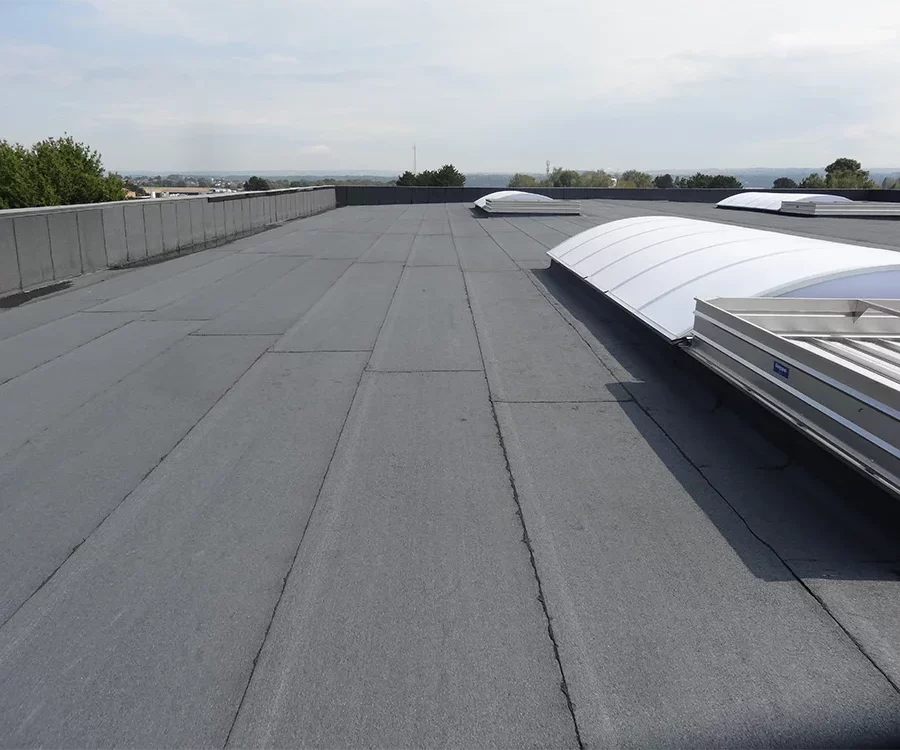
Bituminous roofing
Bituminous systems (roofing) usually consist of multiple layers (underlay + cap sheet) and offer robust and redundant waterproofing. SBS-modified bitumen offers high elasticity and crack-bridging, which is essential for dynamic structures or renovations. APP bitumen performs better at high temperatures and under UV exposure. Thanks to various installation methods (torch-applied, self-adhesive, or cold-glued), this system is widely applicable, including for roofs with intensive use or technical installations.
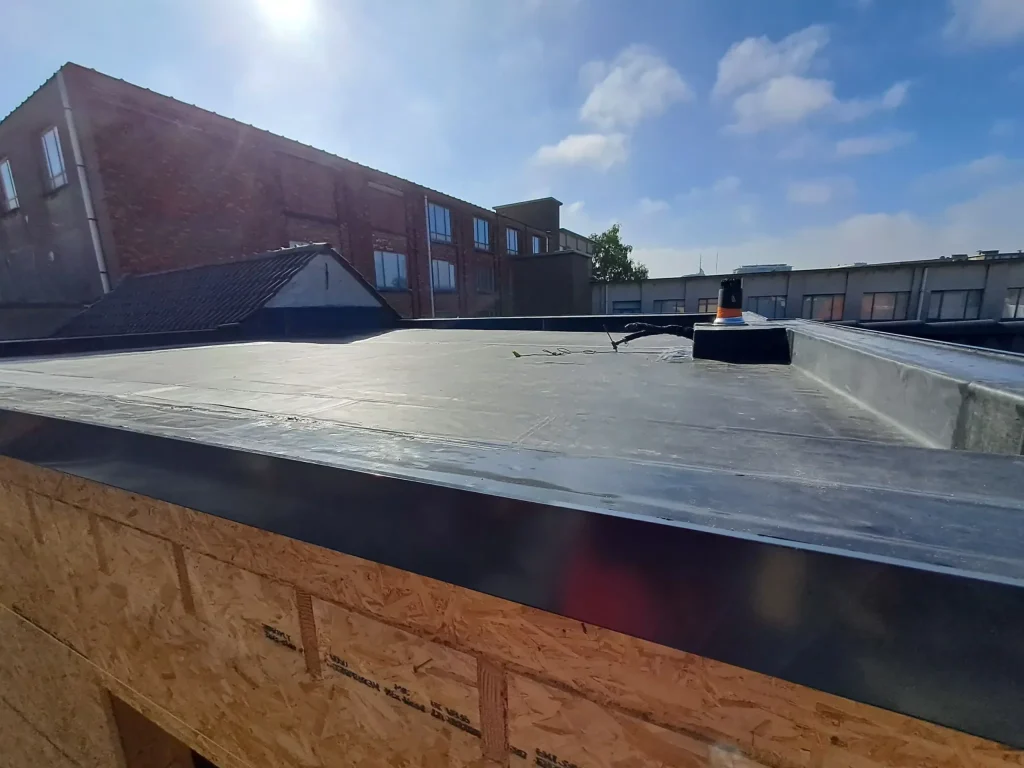
EPDM roofing
EPDM is a thermoset rubber membrane with a proven service life and excellent resistance to UV, ozone, and temperature fluctuations. The material remains flexible at low temperatures and can accommodate large movements without cracking. EPDM is usually glued or mechanically fastened, and the seams are bonded with tapes or adhesives. Due to the limited number of seams and the large roll widths, the risk of leakage is limited. Ideal for projects where durability, low-maintenance solutions, and rapid installation are important.

PVC roofing
PVC membranes are thermally welded, resulting in very strong and homogeneous seams. This type of roofing scores high on chemical resistance and is therefore suitable for industrial applications or roofs with technical installations (e.g., HVAC, kitchens). PVC is also lightweight and suitable for complex roof details. An important point of attention is the aging of plasticizers and the long-term stability of the membrane.
Types of roof extensions and applications
The roof construction largely determines the thermal performance, moisture regulation, and durability of the roof. The positioning of the insulation relative to the load-bearing structure and waterproofing has a direct impact on condensation behavior, energy efficiency, and maintenance.
Warm roof (standard in new construction)
In a warm roof, the insulation is placed on top of the load-bearing structure and beneath the waterproofing. As a result, the structure remains at a stable temperature and the risk of condensation is greatly reduced. This system provides a continuous insulation layer without thermal bridges and offers the best energy performance. Moreover, the roof structure is protected against temperature fluctuations and thermal stresses.
Cold roof (limited application)
In a cold roof, the insulation is located beneath the support structure, causing the roof deck itself to remain cold. This increases the risk of internal condensation and requires proper ventilation of the air cavity. Due to this complexity and these risks, this system is rarely used today in professional projects.
Inverted roof
In an inverted roof, the insulation lies on top of the waterproofing and is protected by a ballast layer (gravel, tiles, or vegetation). This system protects the waterproofing against UV rays, mechanical stress, and temperature fluctuations, which extends its lifespan. It is often used for roof terraces, green roofs, and renovations where the existing roof sealing is retained.
Green roof systems (retention and biodiversity)
Green roofs combine a specific roof structure with water retention and vegetation. In addition to the classic layers (waterproofing, insulation, vapor barrier), you add drainage systems, substrate, and vegetation. These systems play an important role in rainwater management and reduce peak runoff to the sewer system.
White roofs / cool roofs (energy efficiency)
White roofs are based on materials with high solar reflectance and high thermal emittance. As a result, the roof absorbs less heat and the roof temperature remains significantly lower than with dark roofing finishes. This results in a lower cooling demand and increases comfort in the building.
FAQ
1. What roofing material do you choose for a project with high thermal requirements?
EPDM and high-performance bituminous systems (SBS) combine good waterproofing with flexibility. Combined with high-performance insulation and a warm roof assembly, you achieve the best thermal performance.
2. What are the main differences between SBS and APP bitumen?
SBS is more elastic and suitable for dynamic substrates, while APP is more resistant to UV radiation and higher temperatures. The choice depends on exposure and mechanical load.
3. When do you choose an inverted roof instead of a warm roof?
For renovations where the existing waterproofing is retained. The insulation is placed on top and protected with ballast, which limits the impact on execution.
4. What should you take into account when constructing a green roof?
Important aspects are load-bearing capacity, water buffering, root resistance, drainage, and compatibility with the roof waterproofing (e.g., EPDM). A correct buildup is crucial to avoid leaks.
5. What is the added value of a white roof (cool roof)?
A white roof finish reflects a large part of sunlight, lowering the temperature under the roof and improving the building's energy efficiency.