
Reliable connections for pressurized utility pipelines
Within utility pipelines, a durable and leak-free connection is essential. Electrofusion is a commonly used technique for joining HDPE pipes, especially in gas, water, and pressurized sewer applications.
This method uses electrofusion sockets in which an integrated resistance wire heats up the connection in a controlled manner. This creates a homogeneous, strong, and completely waterproof welded joint.
What is electrofusion welding?
During electrofusion welding, HDPE pipes are joined using fittings that are electrically heated. Due to the heat, the pipe and the fitting fuse together into a single unit, without any mechanical connection or additional seal.
Unlike butt fusion, electrofusion offers greater flexibility on the job site, especially with:
- repairs or expansions
- confined space
- complex installations or existing networks
The result is a connection that behaves mechanically like the pipe itself, which is essential in pressurized applications.

Technical advice on electrofusion welding?
Quality of HDPE pipes and sockets
The performance of an electrofusion joint is directly related to the quality of the components used. That is why Deschacht works with systems based on HDPE pipes and fittings from GF, which meet the strictest standards within utility piping.
These systems guarantee:
- a constant welding quality
- compatibility between pipe and socket
- optimal performance under pressure and in the long term
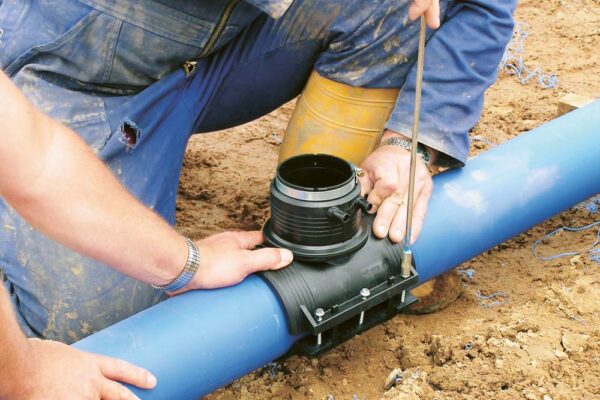
Multijoint
The MULTI/JOINT® 3000 Plus system is the solution for connecting all possible pipe materials in a restraint and tensile-resistant manner. This system has a large range and convenient bolts that are easy to tighten due to their positioning. In accordance with EN 14525 (KIWA BRL-K775/03).
FAQ
1. How is weld quality guaranteed in electric welding?
The weld quality is determined by pre-set parameters in the electrofusion unit, such as voltage, time, and energy input. Modern systems use barcode- or chip-controlled settings to limit errors during the process and guarantee reproducible quality.
2. What are the critical factors for a correct electrofusion weld?
Important factors are pipe surface preparation (scraping and cleaning), correct alignment, fixation during welding, and respecting cooling times. Insufficient preparation can lead to contamination and reduced weld strength.
3. How does the strength of an electrofusion joint compare to the pipe itself?
When correctly executed, the electrofusion fitting forms a homogeneous joint with mechanical properties comparable to those of the pipe. Therefore, the joint does not constitute a weak link in the system, not even under internal pressure loading.
4. Is electrofusion suitable for pressure applications such as gas and drinking water?
Yes, electrofusion joints are extensively used in pressure systems. The leak-tight and structurally strong connection makes them suitable for applications with high demands in terms of reliability, safety, and durability.