
HDPE drainage pipes for sanitary and industrial drainage
A reliable drainage system is essential for the performance, hygiene, and durability of any building. With HDPE drainage pipes, you choose a robust and sustainable solution for the discharge of sanitary wastewater, rainwater, and industrial waste streams. Thanks to their high impact resistance, flexibility, and chemical resistance, HDPE pipes are suitable for both residential and utility projects.
HDPE drainage pipe range
Deschacht is the preferred partner for the distribution of the Akatherm HDPE range. These high-quality drainage pipes combine a long service life with easy installation, offering architects, engineering firms, engineers, and contractors a future-proof solution for various HVAC and drainage projects. The range includes pipes, fittings, and accessories in diameters from 40 to 315 mm.
Why choose HDPE
HDPE (high-density polyethylene) is currently one of the most widely used materials for modern drainage systems. The material combines excellent mechanical properties with high resistance to chemical and thermal loads. As a result, installations continue to function reliably even under harsh conditions.
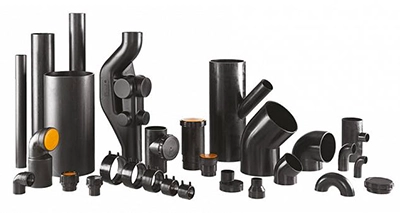
Technical characteristics:
- Mass density: 0.954 g/cm³
- Tensile strength: 85 N/mm²
- Expansion coefficient between 20°C and 90°C: 0.20 mm/m°C
- Available in diameters from 40 up to and including 315 mm
- According to BENOR and NBN EN 1519
Need advice for your HDPE drainage project?
Our specialists will help you with material selection, sizing, specification texts, technical questions, and project support.
FAQ
Why are HDPE drainage pipes often specified in commercial and industrial buildings?
HDPE combines high impact resistance, chemical resistance, and thermal stability. As a result, the pipes continue to function reliably in environments where wastewater reaches higher temperatures or contains aggressive substances. Furthermore, the long service life ensures a lower total cost of ownership.
To what temperature can HDPE drainage pipes be subjected?
Akatherm HDPE drainage pipes are suitable for the discharge of wastewater up to 95°C without restriction in quantity or duration. As a result, they are particularly suited for applications in hospitals, kitchens, industrial buildings, and technical installations.
Which standards and certifications are relevant for HDPE drainage systems?
For building drainage, BENOR certification and conformity with NBN EN 1519 are important quality indicators. These certifications give designers and clients extra assurance regarding performance, quality, and durability.
When do you choose HDPE instead of PVC for wastewater drainage?
For projects where higher mechanical loads, temperature fluctuations, chemical influences, or a longer lifespan are important, HDPE generally offers more advantages than PVC. As a result, HDPE is often used in utility construction, high-rise buildings, industrial installations, and complex technical buildings.