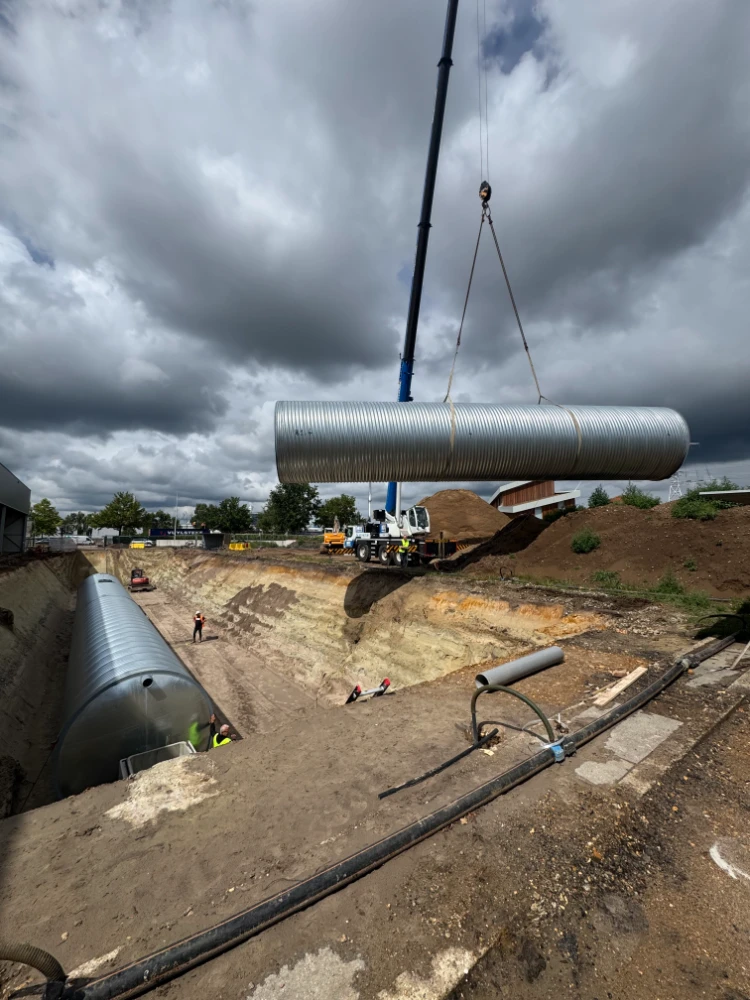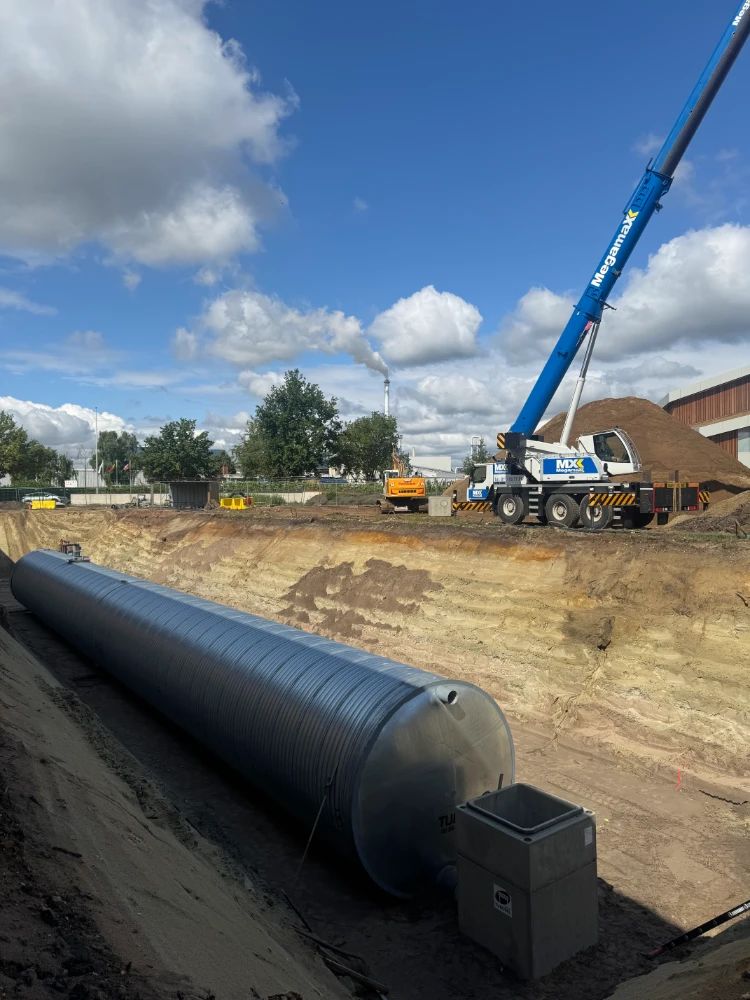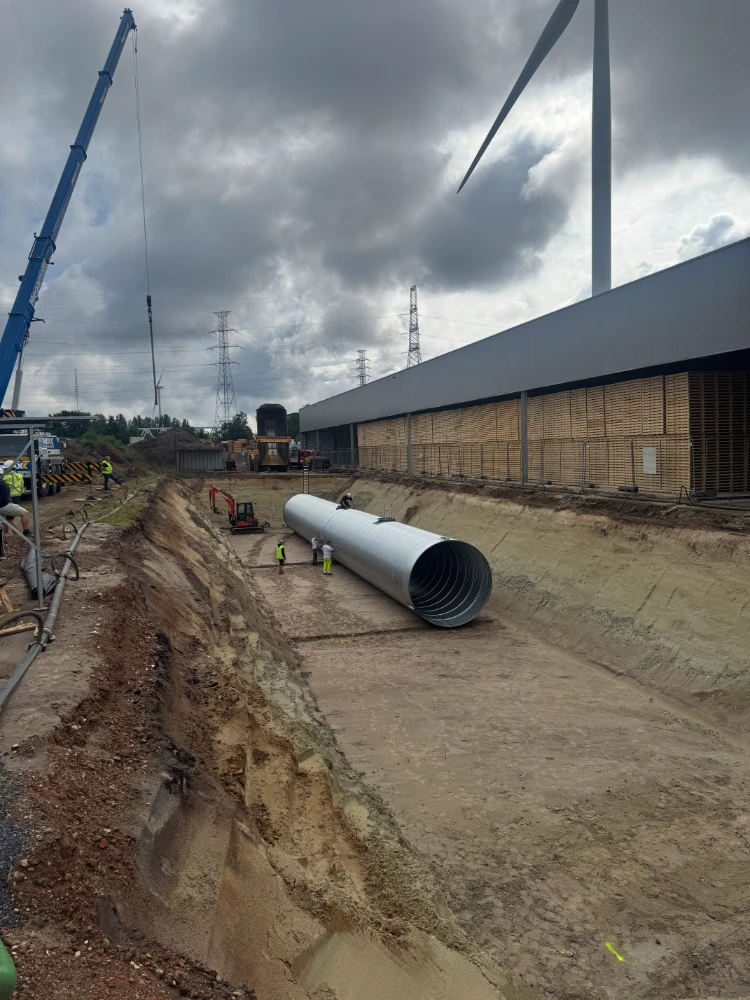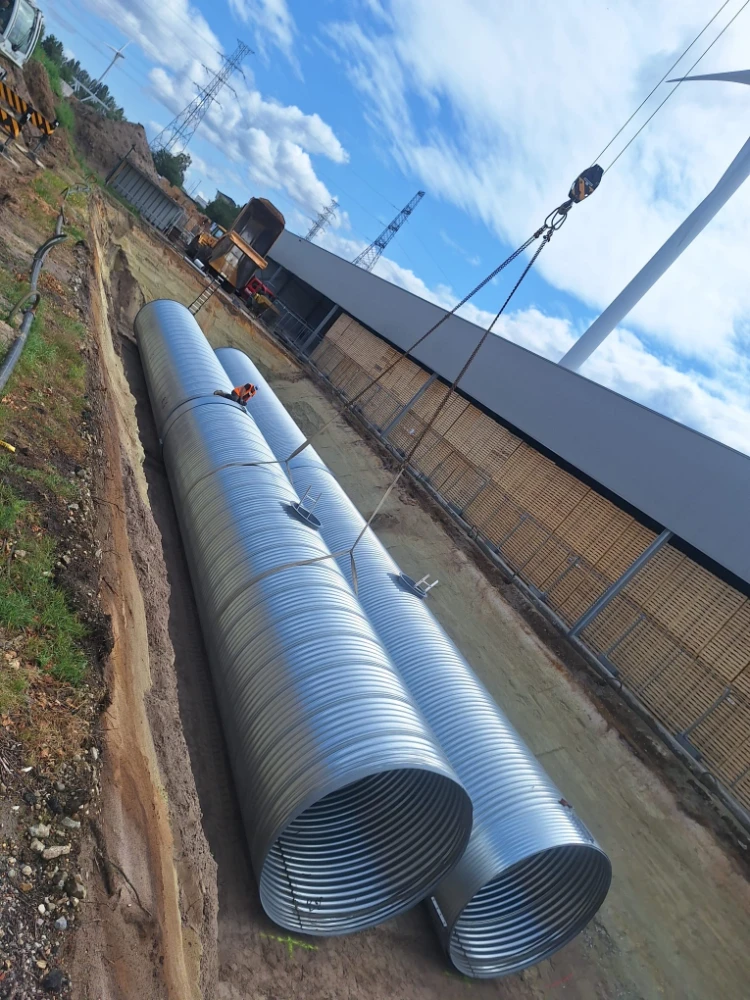
For the expansion of their company site in Genk, Foresco, a specialist in wooden pallets and packaging, enlisted Deschacht in September 2023 to thoroughly optimize their water management. Commissioned by main contractor Edibo, Deschacht worked in close consultation with the client, architect, and contractor Baldewijns on a well-conceived water management plan.
The result? An advanced system that combines maximum infiltration with robust buffer capacity and controlled discharge, fully tailored to the complex context of the site.
Complex project requires smart engineering
The Foresco site, covering 50,000 m², required a sophisticated approach. The technical challenges were significant:
- A large part of the existing pipelines had to be retained.
- The works took place amidst a busy construction site with multiple new buildings under construction.
- The largest infiltration volume was located at the highest point of the site.
- The discharge standards into the street sewer were fixed at 28 l/s (5 l/s/ha).
- The soil needed to provide sufficient infiltration capacity.
- The layout of the wadi was already determined in advance.
Deschacht got to work on this and developed an optimized infiltration plan through its own engineering department. The central objective? To retain as much rainwater as possible locally and infiltrate it in higher areas, and only then discharge it at a delayed rate to lower parts of the site.
Thoughtful sun structure with maximum infiltration
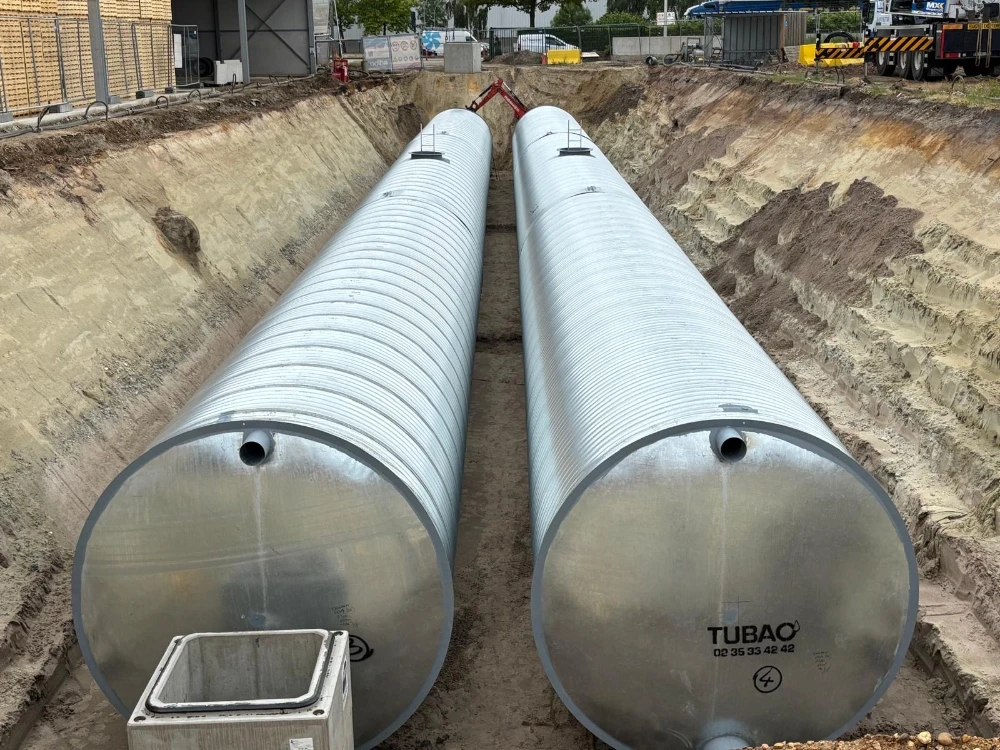
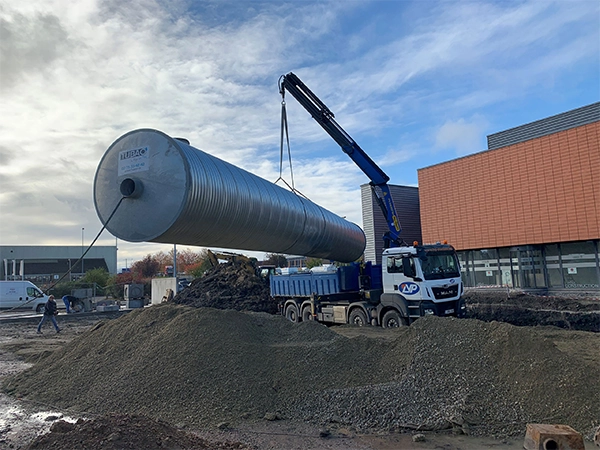
The site was divided into five zones, each with a specific role within the infiltration and buffer system. This allowed us to make optimal use of the existing sewage system, combined with additional infiltration facilities and the various site levels. We also created a delayed outflow between the different zones to give the water maximum opportunity to infiltrate in the higher part of the site. In the lowest zone, there are no swales, but two large Tubao buffer tanks (totalling ± 655 m³) equipped with two pump systems:
- A primary pumping system discharges water to an infiltration ditch at the edge of the site (max. 10 l/s).
- A dual-pump system, tailored to the required discharge capacity of 28 l/s, only activates when there is more than 50 cm of water in the tanks. In this way, as much water as possible is infiltrated before it goes to the sewer system.
Technical elaboration: efficient and sustainable
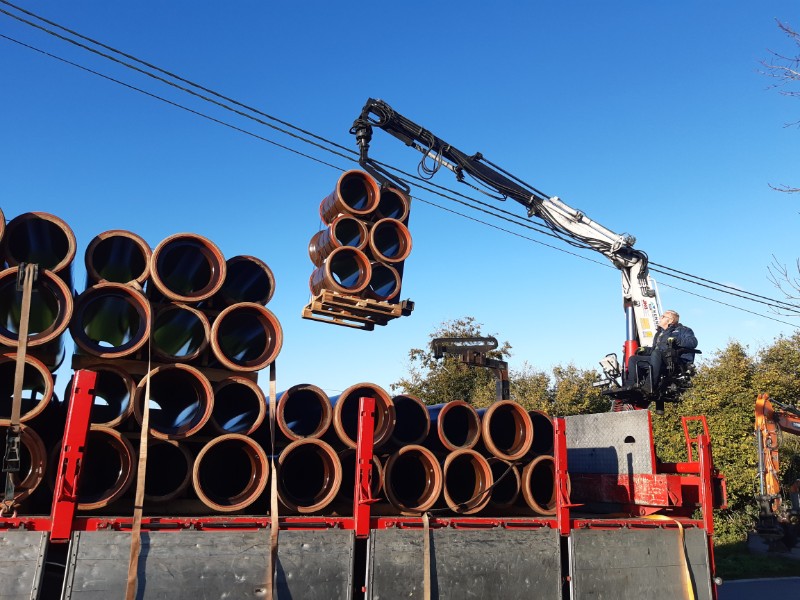
The chosen solution combines Ribwall pipes with the proven Tubao steel buffer tanks. These tanks serve as central buffers and discharge in a controlled manner into the network of interconnected wadis. Important design choices that increase infiltration capacity:
- The water level in the wadis remains on average 30 cm below the surface.
- Each wadi features a smart inlet/drainage construction (30 cm above the bottom) with grates, which ensures forced infiltration and limits the pollution load towards the pipes.
- The bottoms of several wadis lie 80 cm below the ground level, which provides a significant buffer capacity.
- For the new warehouse 6, a new DN500 pipe was provided, connected to the existing pipes of the warehouses.
- The rainwater drainage of the new office building was connected to the existing sewage system.
A Sirio calculation formed the basis of the design. Based on the precipitation simulation, the infiltration volume of the swales was optimized to 1,557 m³, fully aligned with the soil's infiltration capacity.
Implementation partners: Baldewijns and Deschacht
The execution of the earthworks and the installation of the infrastructure were handled by Baldewijns, an established name in infrastructure and hydraulic engineering from Beringen. Thanks to their expertise and the well-conceived preparation by Deschacht, the schedule could be followed closely, despite the complex conditions on the site.
Custom sustainable water management by Foresco
The solution implemented at Foresco is a textbook example of sustainable and future-proof rainwater management. Thanks to the smart combination of infiltration, buffering, and delayed discharge—fully tailored to the site and its constraints—rainwater is kept locally to the maximum extent possible. This increases the infiltration rate, relieves pressure on the sewage network, and provides an answer to tomorrow's climate challenges. Based on the Sirio calculations, we can assume that 89% of the precipitation will infiltrate into the subsoil, while the remaining volume is further divided into reuse and limited discharge into the public sewer system.
Want to know more about engineering and water management?