For a hospital, a good reception of patients and their families is essential. Naturally, this also assumes that there is sufficient parking. But what do you do when your underground parking garage is at risk of flooding? Deschacht, Galère, and Lucas David found a custom solution.
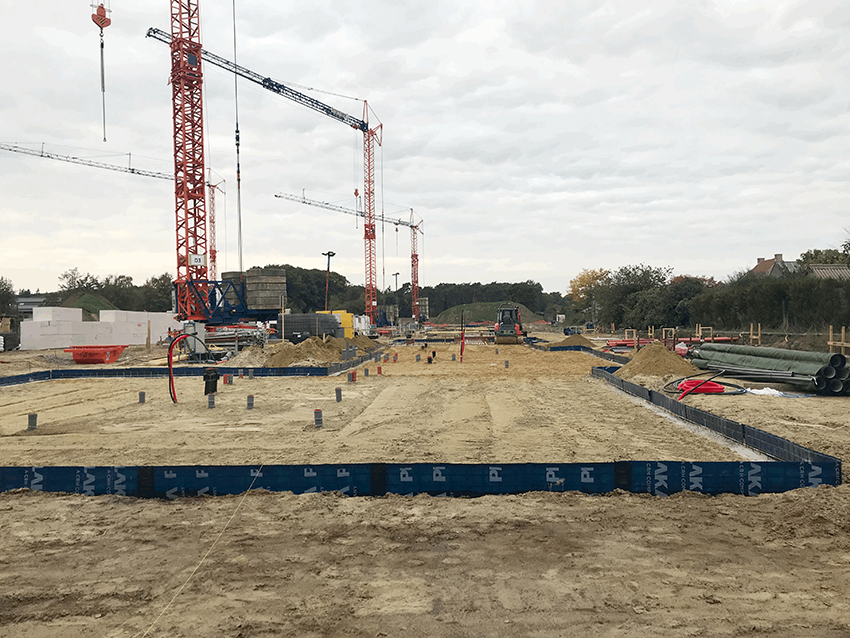
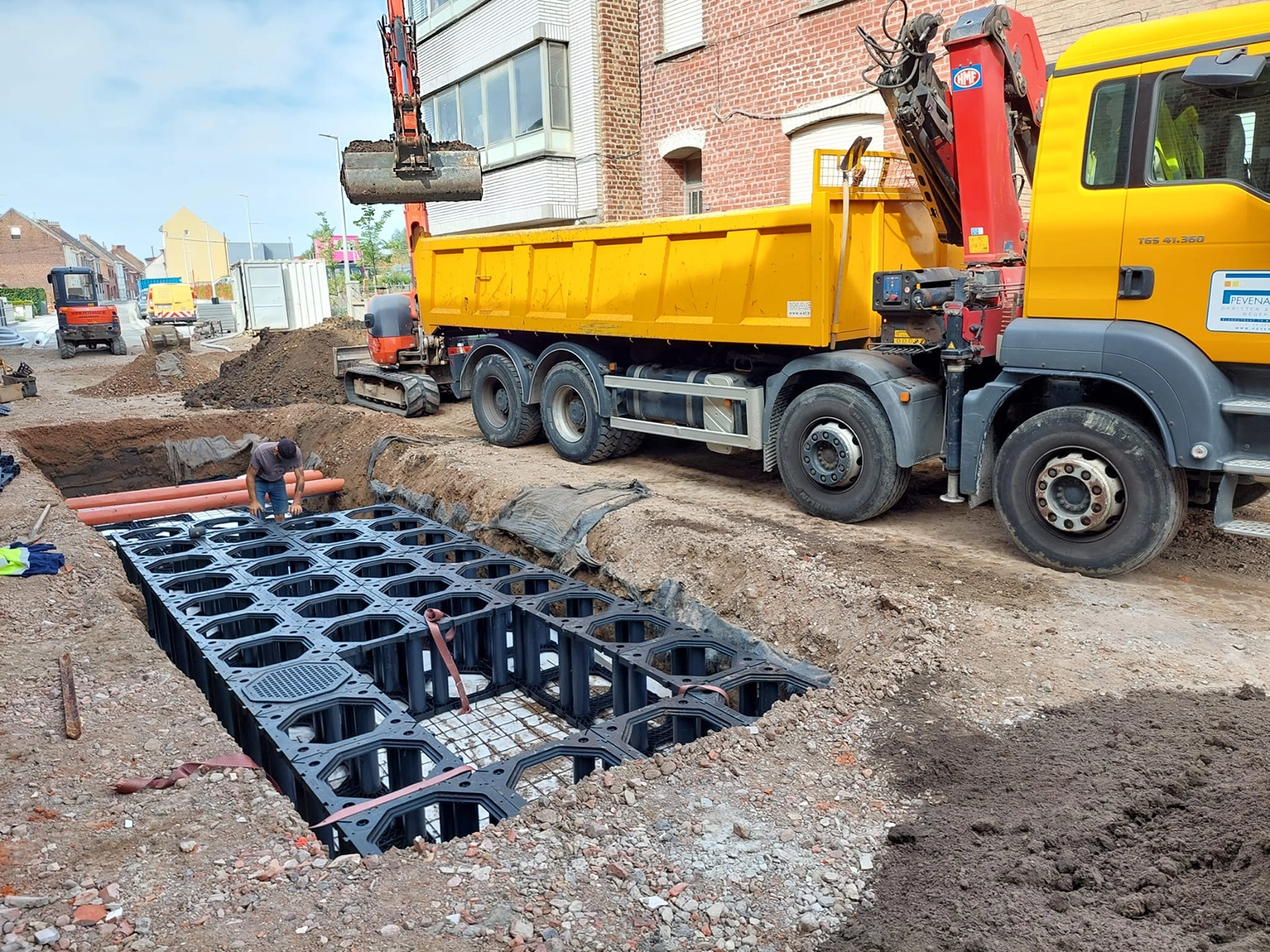
The original two floors of the parking garage at the Namur Regional Hospital need to be expanded to better meet patients“ needs. The new parking garage will have a floor area of 8,000 m² per level, with more than 1,000 parking spaces: an expansion of 50%. Construction began in November 2022 and is divided into two phases, the first of which will be completed on October 2. Why two phases? Because part of the parking garage must remain accessible to patients, employees, and families. For this large-scale project, the parking company Effia enlisted the services of contractor Galère, which entrusted the earthwork and sewerage work to the firm Lucas David. ”To start with, we had to demolish the original parking garage, which had a metal structure, in order to rebuild it with an additional floor,“ explains Matthew Leroy of Lucas David. ”We handled the earthworks and sewer systems using products from Collinet-Deschacht.”
Unexpected water management issues
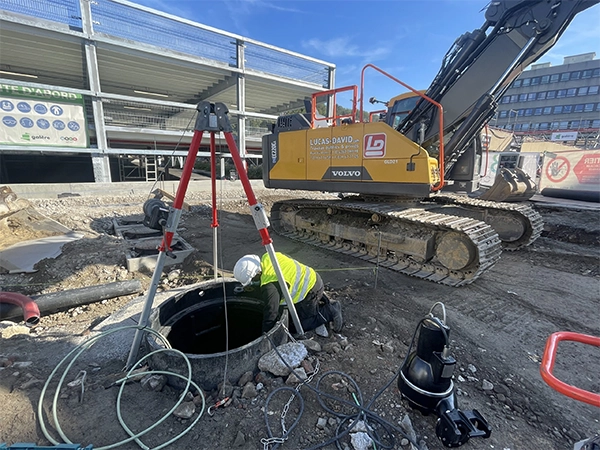
Galère called on an engineering firm to determine the required criteria. Because the parking garage will be in continuous use, it must meet high standards. But the main problem of this construction site turned out to be water management: “We had to go as deep as 4.9 meters with the earthworks, but already at 1.6 meters we encountered groundwater,” says Matthew Leroy. “We were constantly below the water table and had to find a quick and sustainable technical solution to prevent the garage from flooding during thunderstorms.” “When we consulted the engineering firm, they proposed a fairly simple solution: install two pumps so that one would always keep working if the other failed,” says Laurent Demaret, project manager at Galère. “That required the installation of a larger inspection chamber than planned, also because there needed to be sufficient distance between the pumps to avoid a vortex effect. So we opted for an inspection chamber with a diameter of 1.8 meters, custom-made by
The stars of the project: a hydrocarbon separator and a pumping station
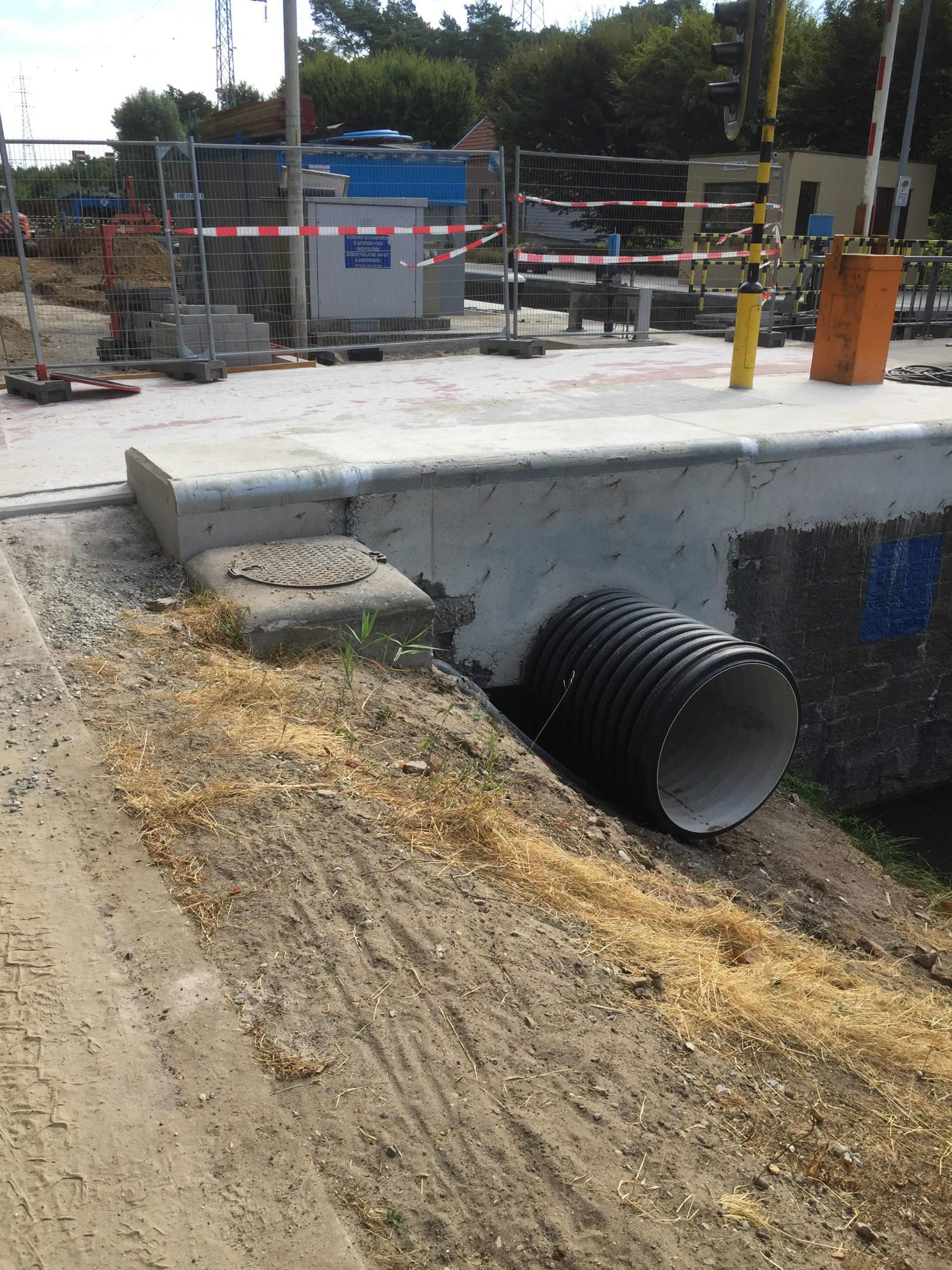
Deschacht not only supplied a HDPE sewerage network with a diameter of 110 to 400 and about ten custom-made polyethylene inspection chambers, but also a HDPE hydrocarbon separator and a double-walled HDPE pumping station with unusual dimensions. “Thanks to Deschacht's engineering department, the expertise of our partner Ecosolutions and the know-how of Collinet, our production workshop, we were able to take on the challenge,” says Dimitri Steilen, project manager at Deschacht. “After all, we had to find a technical solution for the project's problems, such as the groundwater level and the very tight execution schedule. In addition, we had to comply with the engineering firm's requirements regarding the quality of materials and safety standards.” “A HDPE hydrocarbon separator was needed to purify the parking lot water before it goes to the sewer. It now runs through a pumping station that also processes all rainwater. For this, we used a double-walled HDPE tank of Ø1800, 5 meters high, with a 4 m³ water trap and a HDPE ladder, a system with drop grates, and two Grundfos pumps, each capable of handling a flow rate of 30 l/s.” To prevent groundwater pressure from pushing up the various elements, Lucas David installed concrete slabs, along with an anchoring system and a stainless steel hoop.
Polyethylene, an ideal material
The two crucial elements are made of polyethylene, an ideal material for this type of project. “Polyethylene has the advantage of allowing you to create custom products, even when the dimensions are gigantic,” says Dimitri Steilen. “Moreover, it is 100% waterproof and can be installed faster than concrete, for example. That was particularly useful for this site, where we constantly had to pump out groundwater.” The hydrocarbon separator is also equipped with an alarm that will warn the customer when the layer of hydrocarbons has reached its maximum and the separator needs to be emptied. The pump station tank is equipped with a level probe and a control box, allowing the operation of the pumps to be continuously monitored. Furthermore, Ecosolutions offers an annual maintenance and servicing department.
Deschacht, a reliable partner
When it came to choosing a supplier, Lucas David naturally knocked on Collinet-Deschacht's door. “We have been working together for almost 10 years and trust each other,” says Matthew Leroy. “We have excellent contacts and the sales representatives respond quickly when plans change. We were also able to see this in this particularly complex project. Polyethylene products require a special application and theoretical competencies that not everyone possesses, but Deschacht has completely mastered their installation. Moreover, we have already taken training courses at Deschacht to perfect the installation of polyethylene pipes.” The project is now starting its second phase under the best conditions.
Galère SRL
civil engineering and buildings