
Hygienic and sustainable drainage for industry and infrastructure
In industrial environments, public spaces, and infrastructure projects, a high-performance drainage system is essential. Stainless steel drainage channels offer a durable and hygienic solution for the controlled discharge of water, liquids, and waste streams.
At Deschacht, we combine an extensive standard range with custom work and project-level engineering, enabling us to offer solutions that perfectly match your technical and functional requirements.
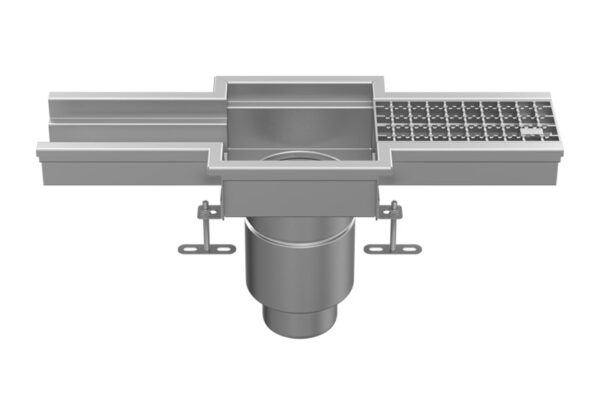
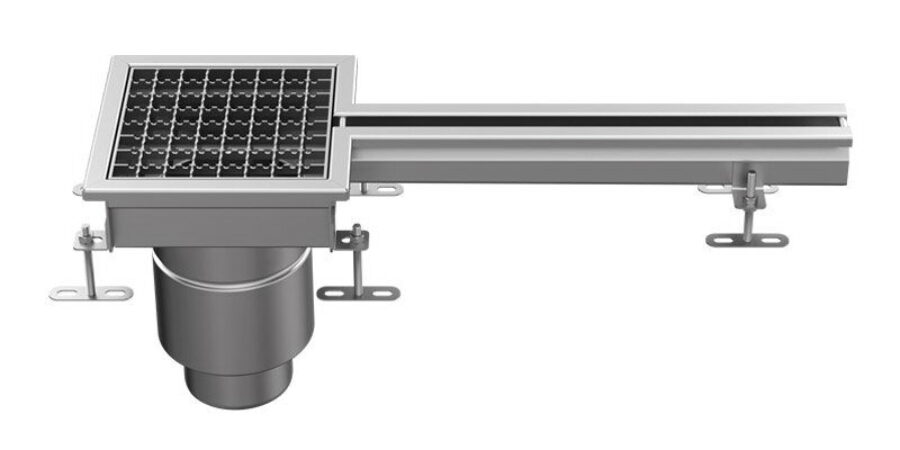
Why choose stainless steel drainage channels?
Stainless steel drainage systems are specifically chosen in environments where hygiene, corrosion resistance, and durability are crucial.
Key benefits:
- completely corrosion-resistant, even in aggressive environments
- hygienic and easy to clean (ideal for industry and food processing)
- resistant to high mechanical and chemical stress
- long lifespan with minimal maintenance costs
For engineering consultancies and contractors, this offers a reliable solution that meets strict standards and operational requirements.
Slot drains and grating drains: the right choice for every application
Depending on the project type, a specific design is chosen. Within stainless steel drainage, we essentially distinguish between two systems.
Slot drains
Slot drains are discrete drainage systems where only a narrow slot is visible at the surface.
Typical characteristics:
- visually impaired aesthetic impact
- ideal for architectural and industrial applications
- suitable for areas with high hygiene requirements
- easy to integrate into paving
They are often used in industry, public spaces, and projects where design and functionality come together.
Grate Gutters
Slot drains combine a drainage channel with a grate cover and are used when higher flow rates or heavy use are expected.
Benefits:
- suitable for high water discharge
- available in various load classes
- easy to access for maintenance
- versatile in industrial and civil applications
For road builders and contractors, grating channels are a robust and practical solution for linear drainage.
Technical advice on stainless steel and engineering
We help you with the development of your project with stainless steel line and point drainage.
Custom work and engineering at the project level
Where standard solutions fall short, Deschacht makes the difference with custom engineering. In many projects, stainless steel drainage channels are combined with, for example, bell traps or specific drainage solutions.
Our approach:
- analysis of flow rates and drainage concept
- sizing based on load and usage
- integration into the overall design (BIM, specifications)
- production and delivery of custom solutions
This makes us a strong partner for:
- industrial new construction and renovation
- complex infrastructure projects
- projects with specific hygienic or technical requirements
Applications of Stainless Steel Drain Channels
Our stainless steel drainage systems are used in a wide range of industries:
- food industry and pharmaceutical sector
- logistics and industrial buildings
- public space and infrastructure
- commercial and industrial construction and technical installations
Thanks to the combination of custom and standard solutions, every project can be carried out correctly and efficiently.
Important considerations for stainless steel drainage
For optimal performance and a long service life, it is important to take into account:
- correct sizing of flow rate and capacity
- choice between slot drain or grating channels according to application
- load class dependent on use
- integration into floor structure and finish
A well-designed system prevents flooding and increases the durability of the infrastructure.
FAQ
1. When do I choose a slot drain instead of a channel drain with grating?
A slot drain is chosen when aesthetics and hygiene are important, such as in industrial or architectural applications. The narrow slot ensures minimal visual impact and limits the accumulation of dirt.
Slot drains, on the other hand, are more suitable when larger flow rates need to be discharged or when easy access for maintenance is required.
2. How is the capacity of a stainless steel drainage channel determined?
The capacity is determined based on:
- the expected water discharge
- the drainage area
- the slope of the subgrade
- the passage opening (slot or grille)
In industrial or infrastructure projects, correct dimensioning is crucial to avoid water accumulation and system overload.
3. What load class do I need for stainless steel drainage channels?
The choice of load class depends on the application:
- light load (A15 – B125): footpaths, indoor areas
- medium duty (C250): parking zones, logistic zones
- heavy duty (D400 and above): industrial applications and road construction
For road construction and industrial applications, higher load classes are typically chosen to withstand long-term loading and point loads.
4. Why is stainless steel used in industrial drainage?
Stainless steel is chosen for:
- high corrosion resistance in aggressive environments
- hygienic properties (smooth surface, easy to clean)
- resistance to chemical substances and temperature variations
This makes stainless steel drainage channels particularly suitable for the food industry, pharmaceutical sector, and other demanding industrial applications.
5. When is custom work necessary for stainless steel drainage channels?
Customization is recommended when:
- standard dimensions do not fit within the project
- specific flow rates or drainage directions are needed
- integration with other elements (such as gullies) is required
- there are high demands regarding hygiene or finishing
In these cases, an engineering process is required to optimally dimension the drainage system and integrate it into the project design.